A capital campaign has the power to transform your church by providing the revenue you need to renovate your buildings, launch new community programming, and more. However, capital campaigns are also major undertakings, and a campaign that falls short of its goal may even harm your church’s public perception.
Fortunately, with the right preparations, tools, and external assistance, your church can take on a capital campaign with confidence.
To help your church start its capital campaign journey, we’ll explore:
- Church Capital Campaigns FAQ
- Capital Campaigns for Churches: Success Factors
- 7 Church Capital Campaign Tips
Whether you’ve just started researching capital campaigns or are already committed to launching one, this guide will help solidify your understanding of the fundamentals and provide key, church-specific campaign tips.

Church Capital Campaigns FAQ
How is a church capital campaign different from other capital campaigns?
Church capital campaigns are fairly similar to capital campaigns run by any other type of nonprofit with one key difference; churches often take inspiration from the Bible or other relevant religious texts and incorporate it into their campaigns. Specifically, this often impacts how churches explain their needs, make their case for support, and connect with donors.
For example, while a secular nonprofit seeks out donors who feel strongly about the organization’s mission, churches may have more faith-oriented conversations with donors that discuss what giving back to their religious community means to them on a spiritual level.
What are the phases of a church capital campaign?
Typically, capital campaigns have five stages:
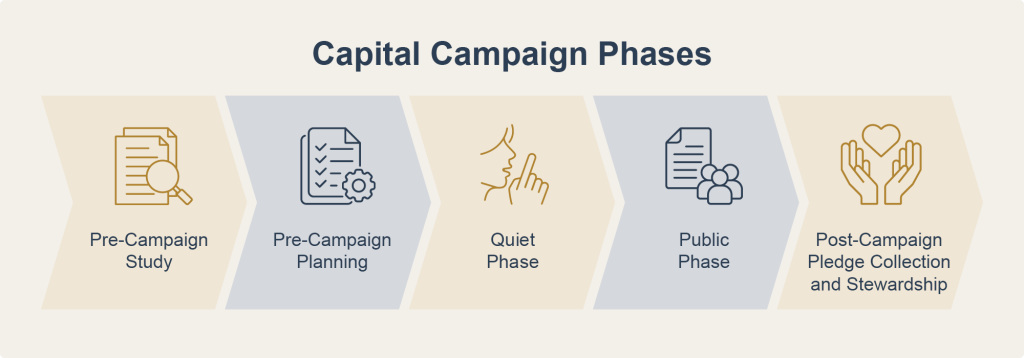
- Pre-campaign Study: Your church partners with a capital campaign consultant to assess its campaign readiness and prepare for the campaign. This process usually involves conducting stakeholder interviews, determining your church’s fundraising capacity, researching donor prospects, and setting achievable goals.
- Pre-Campaign Planning: Using the results of your pre-campaign study, your church will prepare for the campaign by developing materials, like a major giving chart, or finalizing materials based on pre-campaign study feedback, such as your case for support. Churches should also set their campaign budgets, form campaign committees or Cabinets, and find a campaign management consultant to partner with at this stage.
- Quiet Phase: During the quiet phase, your church will approach major giving candidates to request their support. This phase is “quiet” because you have not yet announced your goal to the wider public. However, churches may choose to inform their parishes about their campaigns early on to keep them in the loop and retain their support.
- Public Phase: After securing a significant portion of your fundraising goal during the quiet phase, your church will kick off the public phase by officially announcing its campaign and opening up giving to all donors.
- Post-Campaign Pledge Redemption and Stewardship: Once your church hits its goal, you will announce the campaign’s official wrap-up. At this stage, your church will reach out to donors who pledged major gifts to collect their contributions, continue stewarding them to show your appreciation, and get started on your campaign project.
Depending on your church’s readiness, you may move more quickly through these stages. For example, if your church has conducted capital campaigns in the past, you may have an accelerated pre-campaign study. Alternatively, you may add additional stages, like a pre-campaign study preparation phase.
Should my church run a capital campaign?
A capital campaign is likely the most intensive fundraiser your church will ever conduct, both in terms of time spent on the campaign and in the amount raised. As a result, launching a capital campaign isn’t always the right choice for every church.
To determine if your church should run a campaign, first assess your intended project. Usually, churches run capital campaigns when they have a need that requires major funding, such as a construction project.
Additionally, consider whether your church is currently equipped to complete a multi-year campaign. New churches, churches with few major donors, and churches with limited fundraising capacity can still host capital campaigns, but they will need strong campaign strategies and likely modest goals to succeed.
Capital Campaigns for Churches: Success Factors
When your church hosts a capital campaign, you are asking your most valuable donors to make a major investment in your organization. As a result, a capital campaign that falls short will not only impact your church’s ability to complete its stated project, but can also damage your community’s trust.
Avoid this by assessing your church’s potential for success early on in the capital campaign planning process, such as during—or even before—your pre-campaign study. A few top factors for capital campaign success include:
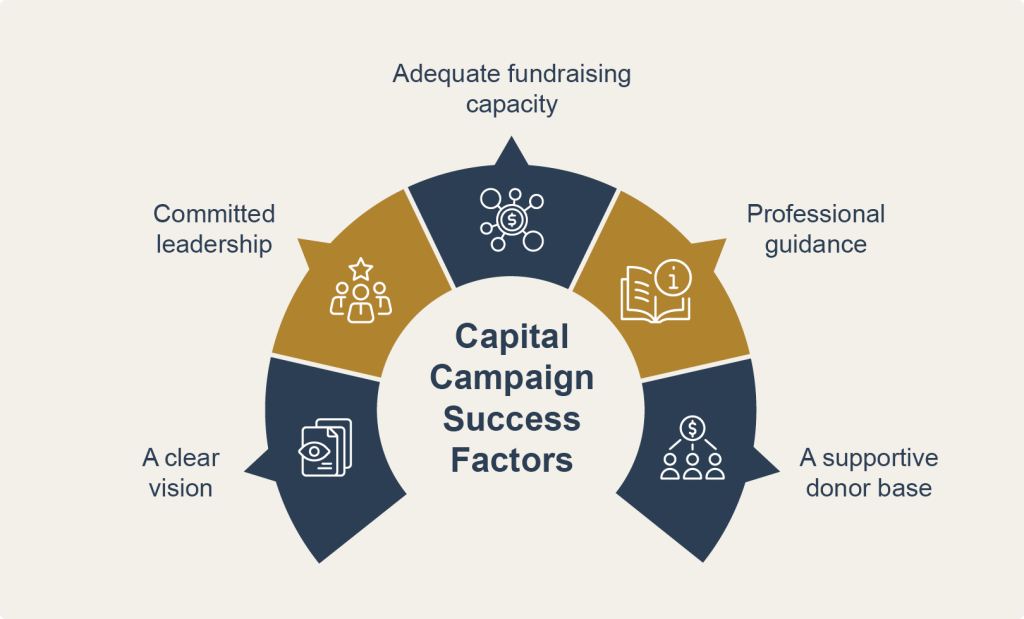
- A clear vision that explains your church’s project and inspires donors to join you in seeing it come to life.
- Committed leadership who understand your campaign and will help you connect with donors, set your budget, and attain necessary campaign resources.
- Adequate fundraising capacity to ensure you can balance your capital campaign and regular fundraising needs.
- Professional guidance from an external, experienced consultant, who can provide an unbiased assessment of your church’s readiness and offer strategic advice to move your campaign forward.
- A supportive donor base who are willing and able to make large enough gifts to meet your campaign goals.
If you are currently unsure of whether your church meets this criteria, ensure you conduct a pre-campaign study. While all churches planning a capital campaign should complete a pre-campaign study, this step is extra important for churches who aren’t sure about their campaign readiness or that are charting out their first campaign.
7 Church Capital Campaign Tips
1. Conduct a pre-campaign study.
Even if you are sure your church will launch a capital campaign, it is still highly recommended you conduct a pre-campaign study, also called a feasibility study. Along with assessing your church’s readiness, a pre-campaign study lays important groundwork for your campaign by:
- Starting conversations with major donors about your campaign, which can jumpstart the solicitation process.
- Gathering feedback about your campaign to help refine your case for support.
- Determine your goal’s feasibility and whether it makes sense to lower or even raise it based on donor interest.
To make the most of the pre- campaign phase, partner with a capital campaign consultant that has experience working with churches. Your church’s involvement in the pre-campaign study depends on your consultant. Some consultants invite their clients to take a more hands-on role during the pre-campaign study to help jumpstart early campaign planning, whereas others primarily handle the pre-campaign study themselves to provide as unbiased a perspective as possible, and others still take an in-between approach.
No matter your consultant’s approach, the pre-campaign study usually involves three steps:
- Preparation for the pre-campaign study, including determining stakeholders to talk to and composing interview questions that will provide insightful feedback.
- Interviews, where the consultant will discuss your campaign with stakeholders, like donors, community members, and even staff at your church.
- Post-study assessment, which involves analyzing the results of the interviews to incorporate stakeholder feedback into campaign materials, identify any challenges the nonprofit will need to overcome before starting the campaign, and determine the overall campaign direction.
In addition to interviews, some consultants will also assess your church’s general fundraising capacity, financial status, and fundraising potential at this stage. For example, a consultant might help you analyze your donor database to see whether you have enough major donors and major giving candidates to support your campaign goal.

2. Keep your parish engaged.
While capital campaigns primarily focus on stewarding major donors, churches should always make their parish a priority. Throughout your campaign, continue to engage your community by hosting all of your regular church activities. This can be challenging to handle on top of your new capital campaign work but is essential for maintaining a thriving, committed community.
Additionally, your parish can help with your campaign. You might ask them to serve as a test audience for your case for support, collect testimonials about their personal experiences with your church or target project issue that you can share with donors, or even invite them to join volunteer campaign committees to help your team plan events, prepare materials, and stay coordinated.
3. Create a clear, focused vision.
When you have a clear, inspiring vision for your project, earning donations is far easier. Avoid hosting a capital campaign just for the sake of fundraising, and instead launch campaigns only when you have a strong, compelling project.
Consider how you can incorporate your faith and your church’s mission into your vision. For example, your church might need a new roof to maintain your building’s structural integrity for years to come, or maybe you’re looking to expand your Sunday school program to provide a stronger religious curriculum. Some churches will also add Bible verses relevant to their project to their case for support.
Of course, ensure your campaign pitch also includes details about logistics and finances to reassure donors they are investing in a well-planned, realistic project. When structuring your case for support, use both inspiring language and real examples to explain your target issue, how your project will solve that issue, and what impact your project will have on your church and your community.
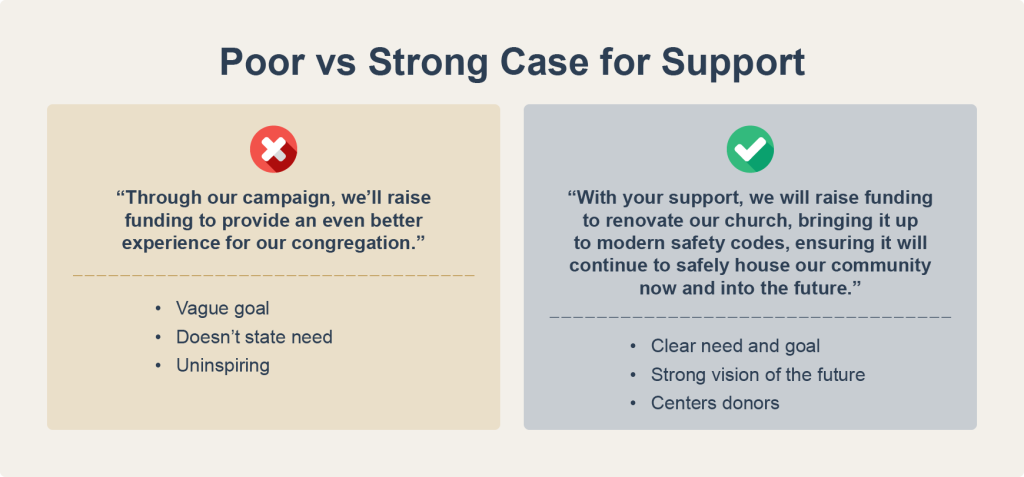
Your pre-campaign study and first donor conversations provide key opportunities to present your case for support and tailor it to address common questions, focus on the most compelling points, and fix any components that may not seem feasible. Additionally, be ready to adapt your case for support as your campaign goes on. Specifically, churches will usually present tailored versions of their case for support to individual donors during the quiet phase, and then create a message that will motivate all supporters during the public phase.
4. Build fundraising capacity.
A capital campaign requires fundraising on a scale far beyond your church’s usual operations. During your pre-campaign study and pre-campaign planning phase, assess your fundraising capacity by evaluating your:
- Team. Meet with everyone at your church who helps out with fundraising to assess their current skill sets. To meet the demands of a capital campaign, some churches will hire new fundraising staff. However, doing so is a major financial commitment that not every church is capable of making. If you do find you need to expand your team, consider how you can get volunteers involved or turn to a capital campaign fundraising consultant who can provide hands-on assistance.
- Tools and resources. What tools does your church currently have to manage its fundraisers? Do you have an online tithing tool? Accounting software? A donor management system? Consider what types of software and other resources your team will need to scale up, whether that means investing in a dedicated fundraising platform or taking your fundraising management digital for the first time.
- Fundraising infrastructure. Analyze the systems and processes your team uses to connect with donors, solicit gifts, and track fundraising progress. Speak with a range of team members involved in fundraising to ask them what they think is working well, what their daily frustrations are, and how they think your fundraising processes could be improved.
Capital campaigns can raise tremendous funding, but your church will need to spend money before that can happen. In general, your campaign budget should be 10% of your goal. For example, a $1 million dollar campaign would have a budget of $100,000 that could be spent on consulting fees, software investments, transportation costs, and new part-time help.
5. Ask major donors to get more involved.
Major donors who give during your capital campaign are making an investment in your church. As such, some of them may be willing to do more to ensure your campaign’s success.
Throughout your campaign, stay connected with your major donors to show your appreciation and provide opportunities for them to get more involved. For example, you might offer them spots on your capital campaign committees to help plan events or conduct outreach. Or, you might ask if they know anyone in their network who may be interested in making a major gift, as well.
Warm donor introductions set up by other donors can help you source new gifts far more quickly than your regular stewardship process. Additionally, ensure you conduct prospect research even on your current major donors to check for new updates in their financial statuses. For example, a current donor might have made a gift to a nonprofit recently alongside several other donors or acquired a new business, signaling that their financial capacity and potential connections have increased.
6. Create clear public phase communications.
Throughout your campaign, you’ll still need to collect regular gifts from tithing and annual fundraisers to keep your church funded. With multiple fundraisers running at once, donors may get confused about which one they should give to or how your capital campaign is different from other fundraisers.
As part of your fundraising strategy, create distinct messaging for each of your campaigns that clearly explain what they are and why they’re worth giving to. For example, if your church is running a capital campaign to renovate your building, you might always add photos of your current building to your campaign messages so your community knows at a glance that you’re specifically discussing your building project.
7. Work with a consultant.
Capital campaign consultants, especially ones who have experience working with churches, can bring vital experience to every phase of your campaign, from the feasibility study to post-campaign wrap up.
While consultants vary in whether they take an advisory or hands-on approach, most consultants will provide the following services:
- Pre-campaign. Consultants can provide an external, professional, and unbiased assessment of your campaign’s readiness, as well as lend their expertise to stakeholder interviews.
- Case for support development. Based on their experience working with churches like yours, consultants can offer targeted feedback or even help draft your case for support if this is your church’s first time writing one.
- Pre-campaign planning assistance. Consultants can lay the framework for your campaign by helping with major gift chart development, staff coaching, donor data analysis, and committee formation.
- Major donor sourcing and solicitation. Consultants can help you analyze your current donor base, community, and other channels to identify prospective major donors, create stewardship plans, and pitch your fundraising asks.
- Post-campaign support. During your campaign, consultants can help you plan your post-campaign strategy, such as how you’ll appreciate donors, provide project updates, and collect campaign pledges.
When it comes to church capital campaign consultants, Ruotolo Associates has the experience and expertise your church needs. Over the course of our 45+ years history, we’ve helped run over 1,000 capital and major gift campaigns, many of them at churches like yours.
With our decades of experience, we’ve helped churches at every campaign stage navigate problems, seize opportunities, and bring to life projects that benefit their communities and their faith-based missions. This means that no matter your church’s campaign needs, we’re ready to help.
Start Your Capital Campaign Off Right
Church capital campaigns succeed when they have a strong foundation, a supportive parish, and an experienced consultant to guide them. Get started with your campaign by connecting with a professional consultant to evaluate your church’s readiness, launch your pre-campaign study, and plan your campaign’s first steps.